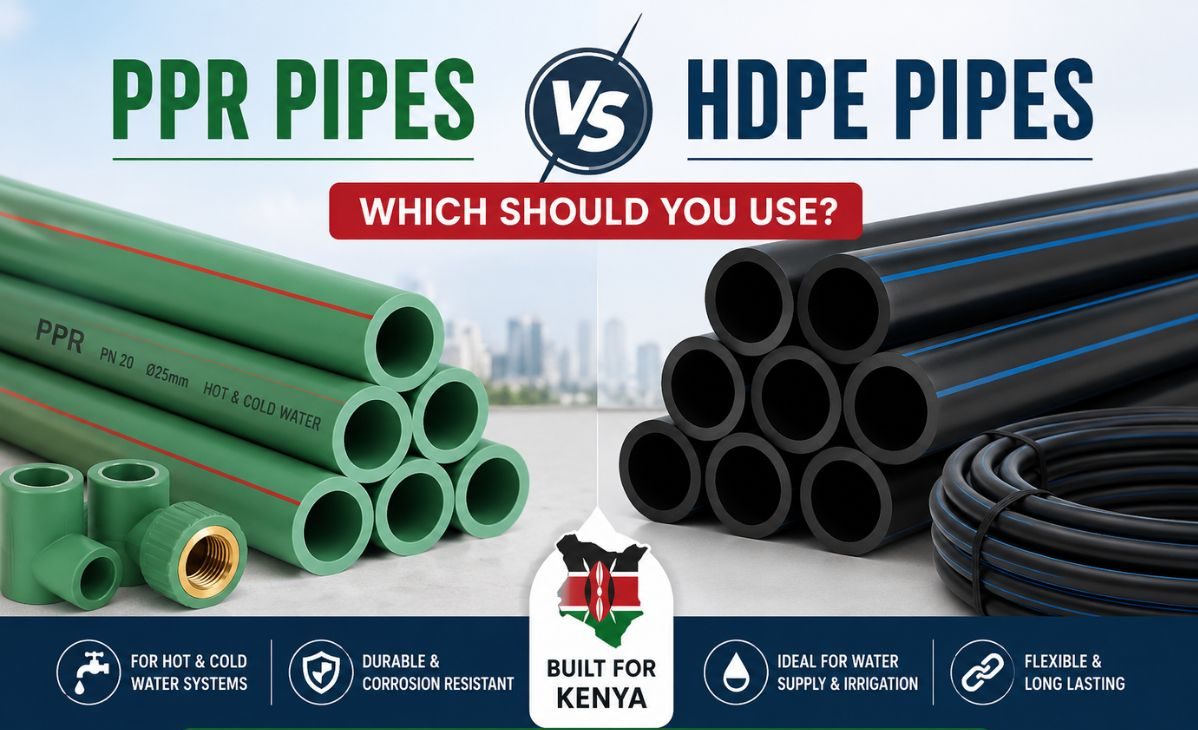
Walk into any hardware store and you’ll find two piping families dominating the shelves: PPR (polypropylene random copolymer) and HDPE (high-density polyethylene). Both are plastic, both are durable — but they are engineered for very different jobs. Specifying the wrong one costs money in fittings, labour and callbacks. Here’s how to choose.
Where PPR Wins
PPR is the standard for indoor hot and cold water plumbing — houses, apartments, hotels and offices. Its joints are heat-fused with a welding machine, so the pipe and fitting become a single piece of plastic with no gasket or glue to fail.
- Handles hot water: rated up to 70–95°C, ideal for shower and solar hot water lines.
- Leak-proof joints: fused connections outlast threaded or glued ones by decades.
- Clean and quiet: smooth bore resists scale, keeps water pressure stable and dampens noise.
- Rigid runs: straight 4-metre lengths chase neatly into walls.
Where HDPE Wins
HDPE is the workhorse for underground mains, borehole lines and irrigation. It comes in long coils (50m and 100m), so you can run water across a plot with almost no joints at all.
- Flexible: follows trench curves without elbows; absorbs ground movement and water hammer.
- Long coils: fewer joints means fewer leak points on long runs.
- UV and impact resistant: the black compound tolerates sun exposure far better than PVC.
- High pressure ratings: PN10 and PN16 grades handle pumped mains and borehole risers.
Quick Comparison
| PPR | HDPE | |
|---|---|---|
| Best for | Indoor hot & cold plumbing | Underground mains, boreholes, irrigation |
| Hot water | Yes (up to ~95°C) | No (cold water only) |
| Jointing | Heat fusion (welded) | Compression fittings / butt fusion |
| Supplied as | 4m rigid lengths | 50–100m coils |
| Common sizes | 20–63mm | 25–110mm |
| Sunlight exposure | Keep covered/chased | Good UV resistance |
The Rule Of Thumb
Inside the building, use PPR. From the meter or borehole to the building, use HDPE. They meet at a transition fitting — usually a female-threaded HDPE compression adapter into a PPR male union. Done properly, that handover point is the only place the two systems touch.
Common Specification Mistakes
- Running PVC or HDPE on a hot water line — it softens and fails.
- Buying PN10 pipe for a pumped line that needs PN16.
- Mixing pipe brands with fitting brands that have slightly different wall tolerances — always fuse-test one joint first.
- Leaving PPR exposed on a rooftop — UV degrades it; sleeve or paint it.
We stock full ranges of PPR, HDPE and PVC pipes with fittings, and we’ll gladly take your plumbing layout and quantify the pipes, fittings and adapters for you — send us your plan on WhatsApp for a free take-off and quote.